
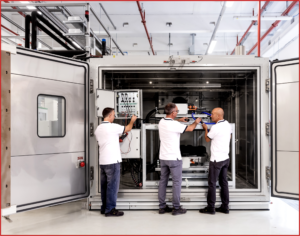
Mark Stewart, Stellantis North America COO, told employees today that the company’s “First Economic Proposal to the UAW” (aka the 2023 contract) includes “significant wage increases in each year of the contract and, in percentage terms, this opening offer is larger than where we ultimately landed in 2019.” The contract, which represents ~43,000 employees expires at 11:59 p.m. on 14 September. The offer came as Stellantis was celebrating the opening of a battery center in Italy saying it was committed to Italian workers. Stellantis resulted from the merger in January 2021 of Fiat Chrysler, aka FCA, and Peugeot or PSA. (AutoInformed: Stellantis Opens Its First Battery Technology Center in Italy)
“This is a responsible and strong offer that positions us to continue providing good jobs for our employees today and in the next generation here in the U.S. It also protects the company’s future ability to continue to compete globally in an industry that is rapidly transitioning to electric vehicles. Because we know this is important to you and your families, we remain committed to bargaining in good faith and reaching a fair agreement,” said Mike Resha, Head of North America Manufacturing. Continue reading







Audi E-Tron and Porsche Taycan EVs Recalled for Battery Fires
Volkswagen Group of America is recalling ~7000 2023 model Audi E-Tron and Porsche Taycan EVs for battery fires. The high-voltage battery may have an insufficient amount of sealant. “Over time, if a sufficient amount of conductive liquid accumulates in the battery, arcing can occur, which could increase the risk of a thermal eve. (recall euphemism for fires – AutoCrat) Volkswagen said in the required National Highway Traffic Safety Administration recall filing documents made public today by NHTSA today “that Insufficiently robust sealant of the high voltage battery can lead to the defect condition, which can allow liquid to accumulate in the battery leading to electrical arcing and fires.”
Battery fires pose a public health threat since they cannot be extinguished with conventional first-responder tools. Continue reading →