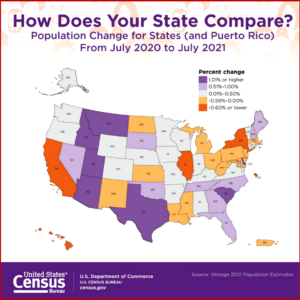
Click to Enlarge.
The population of the United States grew in the past year by 392,665, or 0.1%, the lowest rate since the nation’s founding, according to the Census Bureau. This means that the U.S. population grew at a slower rate in 2021 than in any other year since the founding of the nation, based on historical decennial censuses and annual population estimates. The slow rate of growth can be attributed to decreased net international migration, decreased fertility, and increased mortality due in part to the COVID-19 pandemic. Since April 1, 2020 (Census Day), the nation’s population increased from 331,449,281 to 331,893,745, a gain of 444,464, or a mere 0.13%. Between 2020 and 2021, 33 states saw population increases and 17 states and the District of Columbia lost population, 11 of which had losses of more than 10,000 people. This is an historically large number of states to lose population in one year.
Given our urgent need to be internationally competitive and the staunch Republican opposition to helping poor families and young children in favor of tax cuts for the super wealthy, the news comes at a particularly bad time for the Party of Nope , aka Republicans or the grand old white NOPe. When will they put country over ideological allegiance to what is now the party of insurrection and treason? Continue reading →





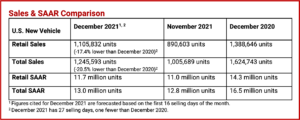






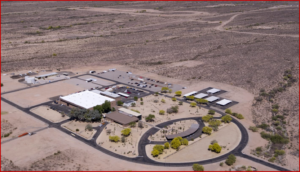

Nissan to Sell Renewable Electricity to Japanese Employees
Pulling the plug on public utilities?
Nissan Motor says it will sell electricity generated from almost 100% renewable energy to its employees in Japan as part of its carbon-neutrality efforts. The program will first be made available to employees living in the Kanto region at the start of fiscal year 2022 at the end of March.
This moves an automaker into an energy segment that is now dominated by public utilities and Big Oil. It could be the beginning of a trend. It also could be the beginnings of massive political and lobbying battles.
Continue reading →