
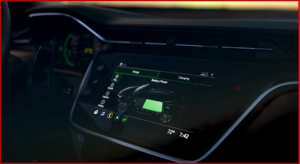
Chevrolet 2022 Bolt Power Flow Screen pre-production. Click to Enlarge.
Chevrolet today shared a peek of the 2022 Bolt EV Power Flow Screen, which will give owners information about their electric vehicle, including regenerative braking [footnote 1] use and battery charge level. The Bolt EUV (electric utility vehicle) will be the first electric vehicle from Chevrolet to offer Super Cruise[footnote 2], the industry’s first true hands-free driver assistance system for divided and compatible highways. The refreshed Bolt EV and the Bolt EUV will go into production in summer 2021. Starting with model year 2020, the Bolt EV has an EPA-estimated 417 km of range on a full charge, a 10% increase (34 km) compared to previous model years. Be aware – as always – actual range will vary based on temperature, terrain, battery age and how a driver uses and maintains the Bolt.
Two trim levels available: LT and Premier are offered. Bolt is pricey starting just under $38,000. Bolt EV’s drive system uses a single, high-capacity electric motor for propulsion capable of producing up to 266 lb.-ft. (360 Nm) of torque and 200 hp (150 kW) of power, enabling 0-96 km/h in 6.5 seconds. Power delivery is controlled by Electronic Precision Shift system. The Bolt EV’s 66 kilowatt-hour lithium-ion battery pack is made up of 288 individual cells. The Standard DC Fast Charging system enables the battery to be charged up to 160km of range in 30 minutes. Continue reading




Kansas City to Assemble All-Electric Ford E-Transit
E-Transit, to be revealed Thursday, is part of Ford’s $11.5 billion-plus investment in electrification through 2022.
Ford Motor Company announced today that its Kansas City Assembly Plant will build the all-new E-Transit van, part of a more than $3.2 billion investment in Ford’s North American manufacturing facilities to produce a series of new electric vehicles for commercial and retail customers. It’s ironic that the transition to a carbon-free economy and the jobs it is now creating in the US auto industry comes in part because of the ousted Trump Administration’s anti-environmental policies that are at odds with a global trend toward healing the earth that is being reinforced by regulators. Ford spends more than $5 billion annually on engineering in America, which includes the development of the all-new, fully electric Transit, the F-150, and the all-new Mustang Mach-E.
Ford’s is changing its manufacturing footprint across North America – working with local and national governments – to lead the transition to electric vehicles and meet consumer demand in the coming years. Electric vehicles are a key part of Ford’s commitment meet the requirements of the Paris Accord – which President elect Biden will rejoin – and achieve carbon neutrality globally by 2050.
Continue reading →