
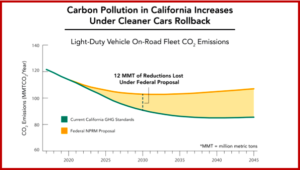
Click to Enlarge.
Yesterday, California led a lawsuit with 22 more states and other jurisdictions challenging the Trump Administration’s plan to roll back vehicle emissions standards. Since these emission rules were enacted eight years ago, they have reduced air pollution and protected the air we breathe. Now the Federal swamp along the banks of the Potomac is over-populated by big money special interests and giving off fetid emissions that need to be cleaned up through more regulation.
The California Air Resources Board helped develop the original 2012 rules and is represented in this case by the California Attorney General. Trump is among global warming deniers, a position – as usual – that has no basis in fact, but is funded by lobbying groups working for those who benefit from exploiting and increasing the use of carbon-based fossil fuels. The 2012 rules would have had automakers increase the average fuel economy of cars and trucks to ~54 miles per gallon by 2025. The new Trump mini-standards require automakers to only improve their average fleet-wide fuel economy to 40 miles per gallon.
Continue reading





Rolls-Royce, Daimler Truck to Develop Stationary Fuel-Cells
A PEM fuel cell is structured like a sandwich. In the center is a thin plastic film, the Proton Exchange Membrane (PEM). This is coated on both sides with a catalyst layer and a gas permeable electrode of graphite paper. The membrane is surrounded by two bipolar plates with milled gas ducts. Through these ducts flows hydrogen one side, and oxygen on the other. Several individual fuel cells are stacked to produce CO2 free energy.
Daimler Truck and Rolls-Royce plan to unite on the development of stationary fuel-cell generators as CO2-neutral emergency power generators for safety-critical facilities such as data centers.
They will offer emission-free alternatives to diesel engines, which are currently used as emergency power generators , or to cover peak loads. They have signed an preliminary agreement, with a comprehensive agreement due and signed by the end of the year.
In April, Daimler Truck and the Volvo Group signed a preliminary, non-binding agreement to establish a new joint venture for the development, production, and sale of fuel-cell systems for heavy-duty commercial vehicles and other uses. The Rolls-Royce Power Systems business unit plans to rely on these fuel-cell systems from the planned joint venture – as well as Daimler’s experience in the emergency power generators it develops and distributes for data centers under the MTU product and solution brand.
Continue reading →