
Click for more.
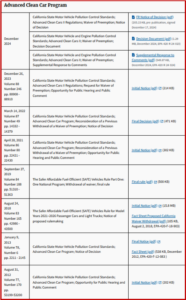
The U.S. Environmental Protection Agency (EPA) today granted two requests from the California Air Resources Board (CARB) for waivers to implement and enforce its Advanced Clean Cars II (ACC II)* regulations for light-duty vehicles, and its “Omnibus” low-NOx regulation for heavy-duty highway and off-road vehicles and engines. Under the Clean Air Act, California can adopt emissions requirements independently from EPA’s regulations to meet its significant air quality challenges. However, California must seek a waiver from EPA for new motor vehicle emission standards.
“After reviewing the information provided by California, reviewing comments submitted by the public, and applying the limited criteria for waiver review under the Clean Air Act, EPA determined in each case that it would be appropriate to grant both waiver requests. The records, included in the waiver decisions, contain public comments on the programs’ feasibility, including costs to manufacturers and the lead time provided. EPA’s review found that opponents of the waivers did not meet their burden to show how either program is inconsistent with the Clean Air Act. California has longstanding authority to request waivers from EPA to protect its residents from dangerous air pollution coming from mobile sources like cars and trucks,” said EPA Administrator Michael S. Regan. “Today’s actions follow through on EPA’s commitment to partner with states to reduce emissions and act on the threat of climate change.” Continue reading



Toyota to Get $4.5M in Fed Funding for EV Batteries
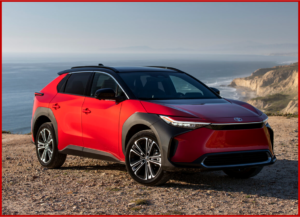
Toyota (NYSE:TM) said today that Toyota Engineering & Manufacturing North America, Inc. (TEMA), inclusive of Toyota Motor North America (TMNA) R&D, has been selected to receive $4.5 million in funding from the U.S. Department of Energy, Advanced Research Projects Agency-Energy (ARPA-E). The funding is part of the Catalyzing Innovative Research for Circular Use of Long-lived Advanced Rechargeables (CIRCULAR) Program, designed to support a circular domestic supply chain for electric vehicle (EV) batteries.
“As it stands, this project and program will highlight avenues for everyone to rethink their approach to battery circularity, and help prioritize the extension of battery life, facilitate battery reuse, and reduce battery waste while unveiling the appropriate pathways to achieve such priorities,” said Nik Singh, principal scientist at TRINA (Toyota Research Institute of North America) who is Principal Investigator on this project. “This is only made possible by the collaboration between the exceptional teams comprised within this project group.” Continue reading →