
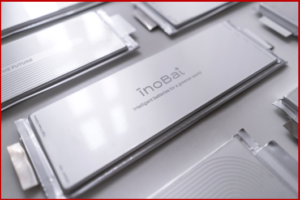
InoBat is backed by a consortium of investors.
The world’s first ‘intelligent’ electric vehicle battery was today revealed today by European EV battery producer, InoBat Auto (InoBat) by the company’s CEO, Marian Bocek*. Speaking at the GLOBSEC Tatra Summit 2020, Bocek claimed that after only a year of research and development, InoBat can now unveil the world’s first battery developed through a combination of Artificial Intelligence (AI) and High Throughput (HTP) technology.
InoBat’s technology-led approach to battery production – it’s claimed – enables them to create better batteries more quickly and efficiently, while delivering an increase in operational range for current best-in-class electric vehicles of almost 20%. This technology enables InoBat to reduce its dependence on cobalt, in addition to also boosting energy density to a goal of 330 Wh/kg and 1,000 Wh/I by the end of 2023. What’s not clear is how InoBat can compete with major automakers, many of whom seeing selling their EV developed technologies to other companies as a way to offset costs and generate profits. GM’s Ultium battery business is just one example. Continue reading


Chinese, Malaysian owned Lotus Engineering Expands Hethel
The Lotus consultancy claims to provide a comprehensive range of technical services to automotive manufacturers and suppliers.
The Asian Investors that own Lotus are making a multi-million-pound investment to enhance the engineering test facilities in Hethel, Norfolk UK. These latest improvements are in addition to an all-new sports car factory, which will be home to an all-new Lotus model next year, along with a new assembly hall dedicated to the Lotus Evija all-electric hypercar. Both will be manufacturing new Lotus cars during 2021. (Lotus at Goodwood Confirms Type 130 Named EVIJA)The Lotus Engineering consultancy seeks to expand its portfolio of services and its client base. It will complement the Lotus Cars business as it prepares to deliver a new range of performance cars – the first of which will be unveiled next year. (The Cora Virus effect is unknown as yet, along with the UK’s trading status with the EU.
Improvements include an all-new Electric Drive Unit (EDU) test cell, plus upgrades to the Internal Combustion Engine (ICE) test and development cells, the Propulsion Prototype build workshop and the vehicle emissions lab. The 2.2-mile Hethel test track – the scene of so much historic race and road car development since Lotus moved to the Norfolk site in 1966 – has also been upgraded. (Renault Group to buy Lotus F1 Team, Raffle by Jim Clark Trust for Lotus Evora, Formula 1: Car by Car 1950–59 Now Available in the U.S.) Continue reading →