
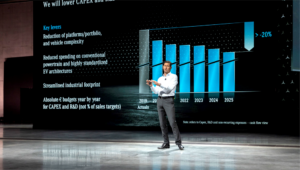
“We are set for profitable growth. Additionally, we have initiated comprehensive measures to bring down the breakeven point in order to right-size our company and our operations.” Click to Enlarge.
Mercedes-Benz today announced a new strategic course that claims will pursue profitable growth in the luxury segment and target leadership in electric drive and car software. This follows the Q2 Daimler disaster. The COVID pandemic or the Grim Reaper saw a decline in demand for cars, vans, trucks and buses. Group total sales decreased by -34% to 541,800 cars and commercial vehicles (Q2 2019: 821,700). Revenue slipped significantly by -29% to €30.2 billion (Q2 2019: €42.7 billion). EBIT was minus -€1,682 million (Q2 2019: minus -€1,558 million). Adjusted EBIT was -€708 million (Q2 2019: plus €2,447 million).
“In recent years we have done many things right: design, product engineering, brand rejuvenation, sales growth. As a result, we have put Mercedes back on top again. But we have not yet lived up to our full potential in terms of turning volume success into profit growth,” said Ola Källenius, Chairman of the Board of Management of Daimler AG and Mercedes-Benz AG at a virtual investor and analyst conference. Continue reading





JR East, Hitachi, Toyota to Develop Fuel Cell Railway Vehicles
Hybari name was adopted to evoke an image of an advanced hybrid railway vehicle equipped with fuel cells and a main circuit storage battery. “HY” represents “hydrogen,” while “HYB” means “hybrid.”
East Japan Railway Company (“JR East”), Hitachi, Ltd., and Toyota Motor Corporation have entered into an agreement to collaborate on development of test railway vehicles equipped with hybrid systems that use hydrogen powered fuel cells and storage batteries as their source of electricity. “By collaborating to develop these test railway vehicles, we aim to further improve the environmental superiority of railways and realize a sustainable society,” the companies said this morning in Japan.
The development of innovative rolling stock powered by hydrogen in theory will contribute to the development of a low-carbon society as it helps to curb global warming and diversify energy sources. Hydrogen ensures minimal environmental impact because it does not emit any carbon dioxide when used as an energy source. It can be produced from various raw materials using renewable energy.
Continue reading →